

News 06.09.2025
Vyzov Foundation Steers Discussion on Regional Science and Technology Development at EEF
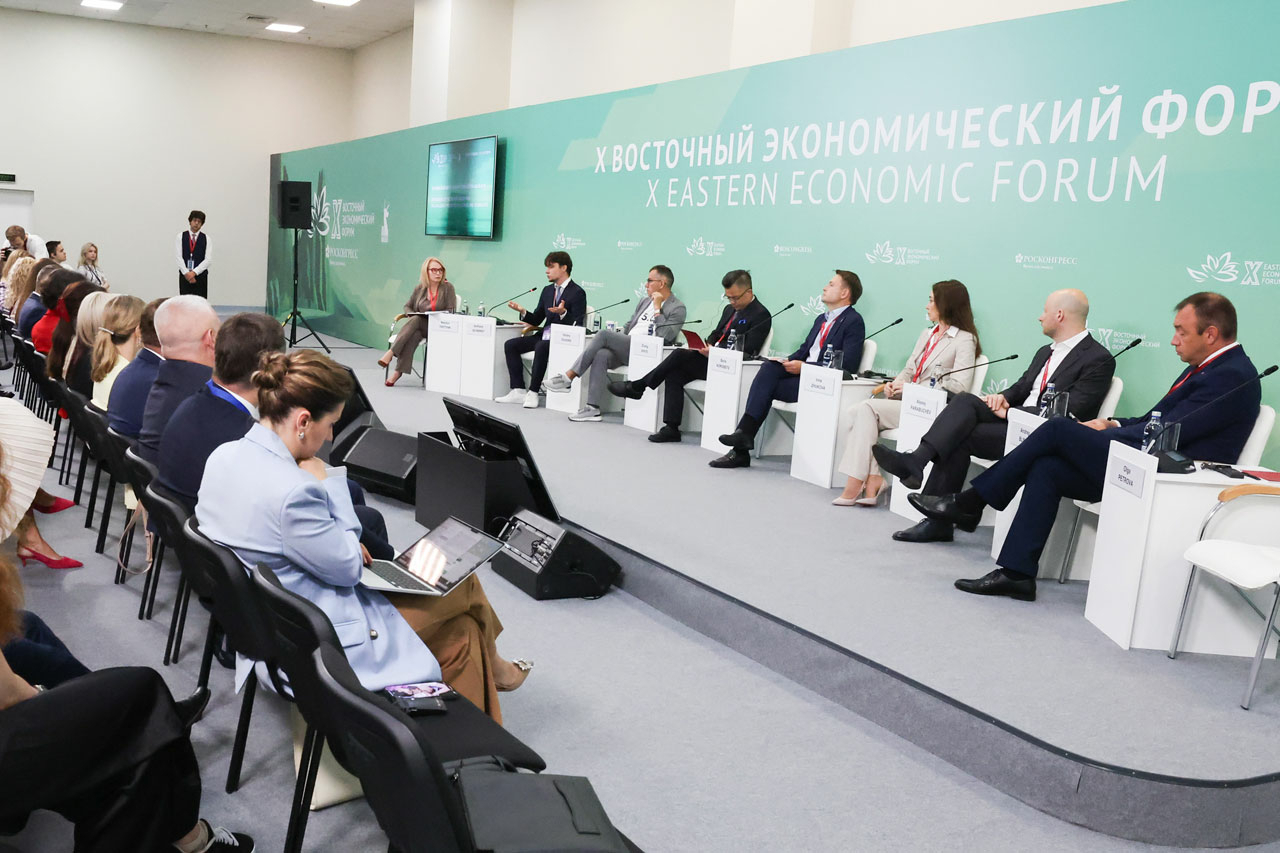
Photo by Dmitry Orlov / Roscongress photo bank
Share


The Eastern Economic Forum featured a session titled ‘Regions of the Future: Science and Technology as a Challenge’ on September 6th, 2025. It was moderated by Natalya Tretyak, Director General of the Vyzov Foundation for the Development of Scientific and Cultural Relations. Which technologies will become the main drivers for development for the regions in the years to come? How can other countries’ experience be applied for developing an efficient national technology policy? What are the ways for encouraging young people to choose a career in science? These were some of the topics discussed by experts coming from the business community, government institutions, scientific organizations and the academia.
Anthony Schwindt, Deputy Head of Secretariat for Deputy Prime Minister of the Russian Federation, Executive Secretary of the Government Commission for Scientific and Technological Development, described the landscape for developing science and technology in the regions. He told the audience there are staff shortages and a disparity in the rate of scientific and technological development between different regions, and it is necessary to build a high-quality system of sectoral and territorial planning to solve these issues: "Scientific and technological development and personnel training cannot exist in isolation from the spatial and economic development strategy that a region chooses for itself. It is the region’s task to figure out which way to move and how to get there, how to use their scientific potential to grow stronger, and how to provide key sectors of their economy with jobs. For this purpose, regions develop their Science and Technology Development Strategies. To use the pilot regions as an example, we are seeing that such a strategy enables a comprehensive approach, as well as integration into the federal science and technology development agenda with all of its available means of government support.”
Olga Petrova, Russia’s Deputy Minister of Science and Higher Education, recalled that just five years ago universities had to compete against each other, whereas today they are actively working together, thanks to the Priority 2030 program and other initiatives: "The Science and Education Centers became the first of such tools. I, myself represented one of the universities at the time. We were told, "Guys, it's time to be friends. Sit down and talk to each other." And we started talking, and suddenly we realized that we weren't competitors at all, that we needed to cooperate. Then the next powerful tool appeared: the world-class campuses. Then the government launched a regional ranking of science and technology development. Governors found themselves being evaluated with regard to their regions’ progress in science. And then it became obvious that you can only develop science if all of your region’s universities work as a unified system."
Dmitry Zauers, Deputy Chairman of the Board of Gazprombank and a Board Member of the Vyzov Foundation, spoke about the role of banks in the process of knowledge transfer to the economy and on the importance of supporting scientific projects, especially those in their initial phase. He emphasized that investment in science and technology is investment in the nation’s future: “By implementing its Bank 5.0 concept, Gazprombank is moving beyond traditional financial services by managing knowledge and technology as an asset. Our focus is cooperation with science and the creation of new industries, which requires long-term planning and building an efficient knowledge transfer process for the economy."
Irina Zhukova, Director General of the Technology Leadership Center and a member of the Expert Panel for the government’s Priority 2030 university support program, described the process of cooperation between the government, businesses and science: "We work at the junction of communications between universities, businesses and government agencies, and we can tell you for sure they all speak different languages. Sometimes they can’t agree on things despite having shared objectives, because they just don't understand each other. We are now seeing a lot of development institutions emerge that organize collaboration between those actors in order to achieve the objectives that we have set ourselves."
Far Eastern Federal University Rector Boris Korobets highlighted the key role that universities play in encouraging young people to go into science. He is convinced that students should be actively involved in scientific activities starting from their freshman year, giving them an opportunity to take part in important projects and advanced research: “The measures we are currently taking to attract and retain young talent are absolutely working. Students are coming to the Far East looking for exciting jobs and interesting research projects, and they stay. It is very important that now there is a system in place for providing government support for such young talent."
Professor Zheng Xinye, Vice President of Renmin University of China, believes that, although every nation walks its own path, no progress or development would be possible without international cooperation and coordination of efforts between nations. Professor Zheng Xinye cited scientific and technological cooperation between China and Russia as an example of an efficient partnership: "Russia is a major supplier of technology and innovation. Russian science has greatly influenced the modern-day world in recent years, particularly the development of China’s regions. It is a very important fact, which the people of China acknowledge and appreciate. What can we do to ensure that benefits are equally distributed globally, so that it wouldn’t be leader-takes-all? I believe China and Russia should think about it together."
Panelists and audience members were invited to take part in a survey on "What is the most urgent challenge for regional science and technology development today?" Natalia Tretyak, Director General of the Vyzov Foundation for the Development of Scientific and Cultural Relations, commented on the polling results and on the discussion itself: "The three main challenges are staff shortage, low integration between science, businesses and the government, and the low prestige of the scientific professions. The Vyzov Foundation, which I head, provides platforms for interaction between scientists, public sector representatives and the business community, and popularizes scientific achievements in order to show that scientists are heroes of our time, and to raise this profession’s prestige. We are facing a lot of challenges, but we will certainly deal with them. After all, a challenge is not only a problem, but also a source of inspiration."