15.05.2026
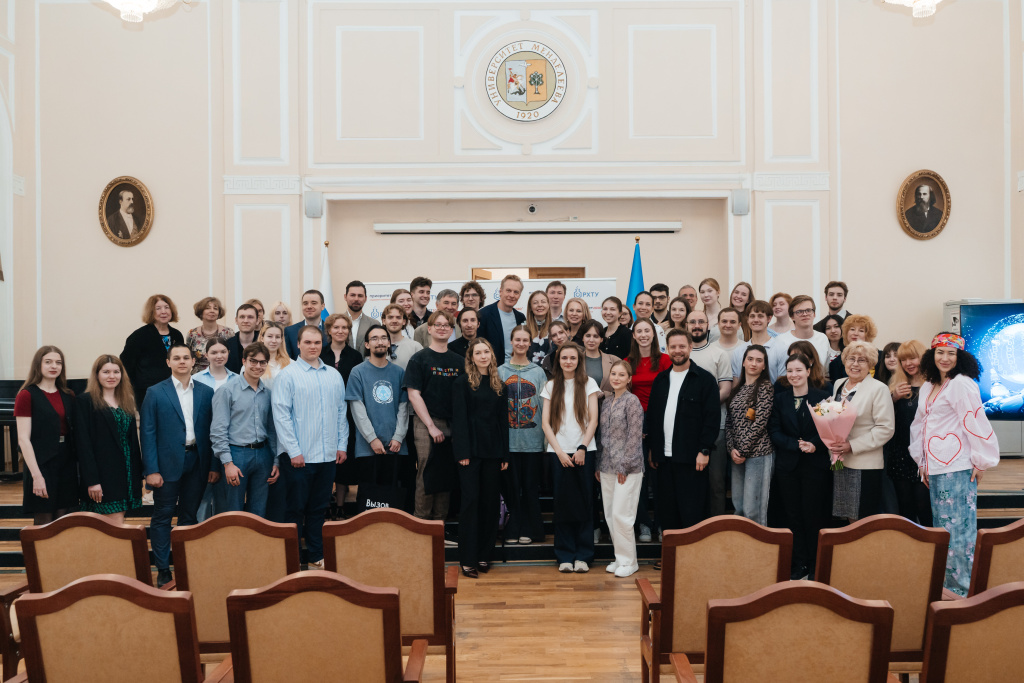
 Can one invent something that has never existed in nature before? And if he can, what does it really take – cutting‑edge AI, precise calculations, or something else entirely? Valery Fokin, a VYZOV Prize laureate and professor at the University of Southern California, thinks that all you need for a breakthrough is plain curiosity. He shared the secret behind the revolutionary CuAAC click chemistry reaction during his lecture Fr om Molecule to Man: The Nature of Scientific Discovery at the Mendeleev University of Chemical Technology.
For Fokin, the driving force behind CuAAC was a simple question: “What if…?” One day, the chemist decided to try and mix copper sulfate with some ascorbic acid from his home first aid kit. And that very experiment captures the essence of discovery – it happens when a scientist goes with their gut.
“There's a certain beauty in uncertainty in life – no rigid expectations, no disappointments,” Valery Fokin said. “This lecture is about staying open, about feeling your way through simple natural processes, almost by taste and touch, and only later figuring out what they really are. So I suppose the gist of the lecture is this: how do you take vague, open‑ended parameters and turn them into something new, useful, and exciting?”

That said, Fokin admitted that not some science experts were skeptical about CuAAC at first – they thought the reaction was too simple and couldn't see any potential. But over time, CuAAC didn't just become the gold standard for click chemistry – it ended up reshaping other fields of science as well. Fokin puts it down to the interest in the process: “This reaction had never existed in nature. Nobody proposed it, predicted it, or pushed it from the outside. And the real beauty is that other researchers can reproduce it and scale it up. People found applications for it that we never could have imagined – in polymers, microelectronics, diagnostics.”

The story of CuAAC creation makes you wonder: could AI ever pull off something like this? Fokin is convinced, though: no matter how advanced neural networks get, they couldn’t come up with a reaction like this. Real progress requires human input. “Algorithms are great at crunching data, but framing the right question – that’s a job for natural intelligence. It takes experience, it takes deep understanding of the subject matter – things that come from people, never from AI,” Fokin concluded.